Porch note
Why Ice Cubes Come Out Hollow
A hollow cube is a water problem wearing a temperature problem's clothes. Here is how to tell the two apart before you call anyone.
5 min read ice and water
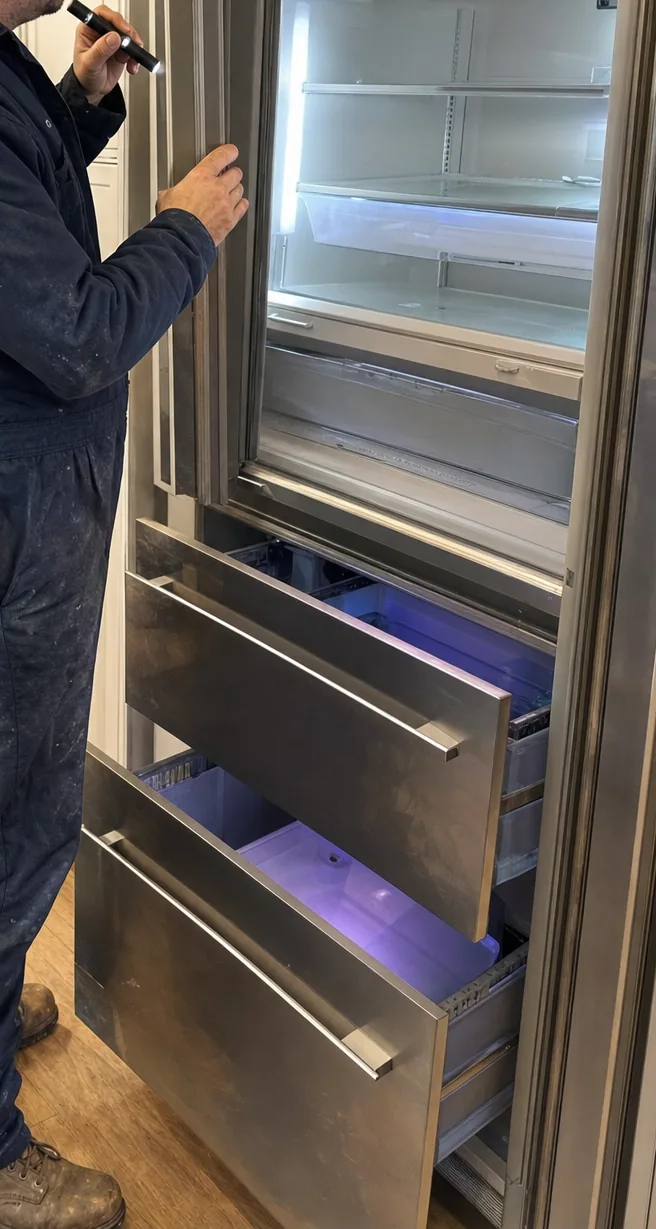
A hollow cube looks like a freezing problem. It is almost never a freezing problem.
Here is the sequence an ice maker actually runs. The fill valve opens for a fixed number of seconds and lets water into the mould. The mould sits there while the freezer does its ordinary work. At the end of the cycle the mould is warmed slightly, the bond breaks, and the cubes are swept out into the bin. Then it starts again.
Notice what is missing from that description: at no point does the machine check whether the mould actually filled. The timing is fixed. The machine assumes the valve delivered what it was asked for.
Why a short fill produces a shell
Water freezes from the outside in. A full mould freezes into a solid cube because there is water all the way through. A mould that only received two thirds of its shot freezes a shell first, and there is nothing left in the middle to fill it. When the harvest cycle sweeps it out, you get a cube that is the right shape and the wrong weight, and often one that collapses in a glass.
If the cabinet were genuinely too warm, you would not get hollow cubes. You would get soft ones, or slushy ones, or none at all — and the ice cream two shelves down would be telling you the same story. Check the food before you blame the temperature. Firm food plus poor ice is a water problem, every time.
Where short fills come from
In rough order of how often we find them:
Mineral deposit on the valve seat. Every fill leaves a trace behind on the seat the water passes through. Over years the passage narrows, the same number of seconds delivers less water, and the cube gets progressively lighter. This is the slow, gradual version, and it is the one we find most often.
A restricted supply line. The line feeding the refrigerator is often original to the last kitchen remodel. Twenty-five years of the same water has the same effect on a quarter-inch line that it has on a valve seat, and a kinked or partly crushed line behind a cabinet does it faster.
A failing valve. Solenoid valves do eventually fail, and when they do it is usually more sudden — cubes were normal, then they were not.
Low household pressure at the moment of fill. Less common, but real if something else in the house draws hard at the same time.
Two things to notice before you call
Did it arrive gradually or suddenly? A gradual decline over a season or two points at deposit, in the valve or the line. A change you can date to a particular week points at the valve, the line being disturbed, or something that happened to the plumbing.
Has anything else that meters water slowed down? If a bathroom fixture or another appliance changed at the same time, the problem is upstream of the refrigerator entirely and the ice maker is just the most sensitive instrument in the house.
What the repair looks like
We measure the actual fill volume rather than inferring it, check pressure at the appliance, inspect the valve and the line, and look at the mould surface. Replacing a valve that is being fed by a restricted line is a repair that lasts about eighteen months, so the line gets checked either way.
Sometimes the answer is a part. Sometimes the answer is that the line needs replacing and the valve is fine. Occasionally the answer is that the machine is healthy and the household is simply asking more of it in August than it did in February, in which case you have bought a straight answer and not a part you did not need.
The diagnostic is a flat $80 and comes off the repair if you go ahead.
What it costs
What does putting this right cost?
The bands that fit what this note is about. The diagnostic comes first and is credited toward the repair.
| What is being put right | Parts and labour |
|---|---|
| Diagnostic visit | $80 flat, credited toward the repair |
| Ice maker, water valve or supply line | $250–$650 parts and labour, after the diagnostic |
Every line above is a range because the firm figure is written down after the diagnosis and not before it. The $80 covers coming out, testing the system and telling you what is wrong, and it comes off the repair the moment you say go ahead. The whole table, and what happens when a repair is not worth doing, is on the what it costs page.
If this is your fault
The repair page for it
- Sub-Zero ice maker filling short: hollow cubes, no harvest Thin cubes, hollow cubes, a mould that fills but never harvests, and production that falls away through the summer.
Where this comes up
- Mandarin The home ground. Established subdivisions on generous lots, riverfront estates along Mandarin Road, and kitchens that were mostly remodelled around the appliance.
- Loretto The middle of Mandarin, and the neighbourhood this shop is named after. Established houses, remodelled kitchens, and original water lines.
All of the porch notes are listed on the reading page.
These notes are about cold: Sub-Zero refrigeration in Mandarin kitchens. Where one of them mentions a room being air conditioned, or a storm taking the power out, it is describing the conditions the cabinet works in. Loretto Cold Service does not service heating, air conditioning or ductwork and does not install them.
Questions we are asked
What readers ask after this one
- Do hollow cubes mean the freezer is not cold enough?
- Almost never. The mould is filled by a timed shot of water and harvested on a fixed schedule, so a short fill freezes from the outside inward and comes out as a shell while the compartment sits exactly on its setting. It is a water problem wearing a temperature problem's clothes.
- What is worth noticing before calling anyone?
- Whether the cubes are small as well as hollow, and whether output fell away suddenly or over years. A gradual decline points at a restriction building up on the way in. A sudden stop points somewhere else entirely, and saying which one you have shortens the visit.
Customer reviews
Owners who called about something like this
Three of the pool, chosen by this page and printed in full.
4.64.6 out of 5 across all 64 reviews published on this site
5 out of 5
The cubes had gone small and light over about two years. He measured what was arriving at the valve before touching anything and found the supply restricted rather than the machine itself at fault.
Odalys N.July 2026
5 out of 5
The line feeding our ice maker was original to the house and kinked behind the cabinet. He replaced the run instead of the valve, and said a valve fed by a restricted line would only buy us a year.
Fenwick S.July 2026
5 out of 5
We were getting a thin sheet of ice instead of cubes. He measured the fill volume, found the valve leaking through, and swapped it. He fitted a filter as well, because our water is hard enough to matter.
Ossian P.April 2026
A wider selection, three-star entries first, is on the reviews page. All 64 are published across this site, beside the repair or the street each one came from.