Porch note
Frost on the Back Wall of the Freezer
Frost is not the freezer being too cold. It is humidity that entered the cabinet and then failed to be removed on the next defrost.
5 min read temperature
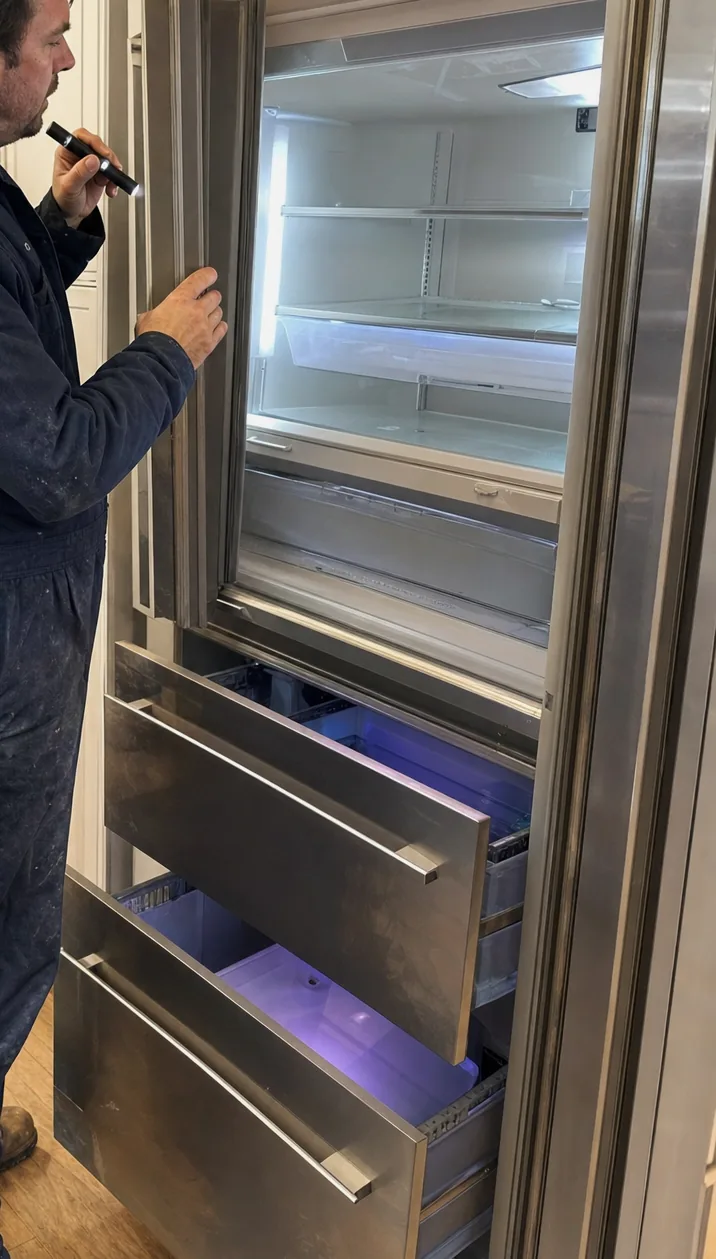
Frost inside a freezer feels like proof that the appliance is working too hard. It is the opposite. Frost is water that should not have been in the cabinet, or that should have been carried away and was not.
Every freezer takes on a little moisture. Air enters when the door opens, food gives some off, and the cold surfaces inside condense it out. The appliance deals with this by defrosting on a cycle: the evaporator coil is warmed briefly, the accumulated ice melts, and the water runs down a drain and out to a tray where it evaporates. When that cycle works, you never see any of it happen.
When frost is visible on the back wall, one of two things is true. Either far more moisture is arriving than usual, or the defrost is no longer clearing what arrives.
Read the pattern before you call
Where the ice is tells you a great deal.
Even, feathery frost across the whole back panel usually points at the defrost cycle. The coil is behind that panel; if the panel is uniformly iced, the coil behind it is iced too, and the machine has stopped clearing it.
Frost heaviest around one edge of the door, or one corner points at the seal. Warm damp air is entering at that point and condensing on the first cold surface it meets. Run a hand along the gasket on a humid morning — a stretch that feels cooler and damper than the rest is where it is losing.
Ice in the base of the cabinet, under the lowest basket usually means the drain is blocked or frozen. The defrost is running, the ice is melting, and the meltwater has nowhere to go, so it refreezes at the bottom.
Frost on food but not on the walls is a different thing entirely: that is usually air movement across uncovered food, or food that was put in warm.
The Mandarin summer makes all of this worse
From June into September the dew point here sits high enough that room air carries a lot of water. Every second the door is open, and every second an imperfect seal is letting air past, the cabinet is being fed that air. A gasket that would go unnoticed in a dry climate produces visible ice here within weeks.
This is also why frost complaints arrive seasonally. The seal did not fail in June. It failed slowly over two or three years and June is simply when the consequences became visible.
What we check
The defrost circuit first, because it is the most common cause and the most diagnosable: whether the coil is being warmed at all, whether it is being warmed long enough, and whether the control is calling for it. Then the seal, along its whole run rather than at one corner. Then the drain path. Then the door alignment, because a door that no longer sits true will defeat a perfectly good gasket.
Why it matters even though the food is fine
A freezer full of frost is still keeping food frozen, so it is easy to live with. What it is quietly doing is insulating the evaporator coil under a layer of ice, which makes the coil less able to absorb heat, which makes the compressor run longer for the same result. Left alone long enough, the ice builds until it fouls a fan blade or blocks the airflow path completely, and then a small repair becomes a larger one.
Scraping it out buys a few weeks. It does not address why it arrived.
If you are seeing frost, note where it is thickest, note whether it comes back quickly after you clear it, and mention both when you call. The diagnostic is a flat $80, credited toward the repair.
What it costs
What does putting this right cost?
The bands that fit what this note is about. The diagnostic comes first and is credited toward the repair.
| What is being put right | Parts and labour |
|---|---|
| Diagnostic visit | $80 flat, credited toward the repair |
| Evaporator or condenser fan motor | $250–$550 parts and labour, after the diagnostic |
| Defrost heater, thermostat or sensor | $250–$640 parts and labour, after the diagnostic |
Every line above is a range because the firm figure is written down after the diagnosis and not before it. The $80 covers coming out, testing the system and telling you what is wrong, and it comes off the repair the moment you say go ahead. The whole table, and what happens when a repair is not worth doing, is on the what it costs page.
If this is your fault
The repair page for it
- Sub-Zero built-in refrigerator running warm on one side A cabinet running warm on one side, frost creeping across the freezer wall, or a unit that runs and runs without ever settling down.
- Sub-Zero integrated column: door out of true, drawers icing Panel-ready refrigerator and freezer columns that sit flush with the cabinetry until something moves, ices up or stops responding.
Where this comes up
- Mandarin The home ground. Established subdivisions on generous lots, riverfront estates along Mandarin Road, and kitchens that were mostly remodelled around the appliance.
- Beauclerc The northern end of Mandarin along the San Jose Boulevard corridor, where 1960s and 1970s kitchens were never sized for a modern built-in.
All of the porch notes are listed on the reading page.
These notes are about cold: Sub-Zero refrigeration in Mandarin kitchens. Where one of them mentions a room being air conditioned, or a storm taking the power out, it is describing the conditions the cabinet works in. Loretto Cold Service does not service heating, air conditioning or ductwork and does not install them.
Questions we are asked
What readers ask after this one
- Should I defrost the freezer myself first?
- Clearing it is fine and it tells you something useful. What matters is how long the frost takes to come back. Returning within days points at air getting in or a defrost cycle that is no longer clearing the coil; a slow return over months is much closer to ordinary use.
- Is the food at risk while there is frost on the back wall?
- Usually not straight away, which is why this gets left. The compartment can hold its temperature while the coil ices up, and the cost is paid in compressor hours rather than in spoiled food. It is worth acting on before the airflow closes down enough to change that.
Customer reviews
Owners who called about something like this
Three of the pool, chosen by this page and printed in full.
4.64.6 out of 5 across all 64 reviews published on this site
5 out of 5
He told me plainly that the noise I had been worrying about was a fan bearing starting to talk, not the compressor. Cheaper part, fitted the same afternoon, and the kitchen is quiet again.
Merritt B.July 2026
4 out of 5
Water was tracking down the inside of the cabinet and freezing at the base. He cleared the drain line, found the heater that keeps it open had failed, and fitted a new one so it would not simply return.
Perpetue G.January 2026
5 out of 5
The fresh food side sat at fifty while the freezer was perfectly fine. He traced it to the evaporator fan in that one compartment rather than the whole machine, and explained why the two sides behave separately.
Rosalind T.September 2026
A wider selection, three-star entries first, is on the reviews page. All 64 are published across this site, beside the repair or the street each one came from.