Porch note
The Condenser Is Above the Doors, Not Below
The one piece of maintenance that reliably extends the life of a compressor, and the first thing we check on any cabinet that never stops running.
5 min read maintenance
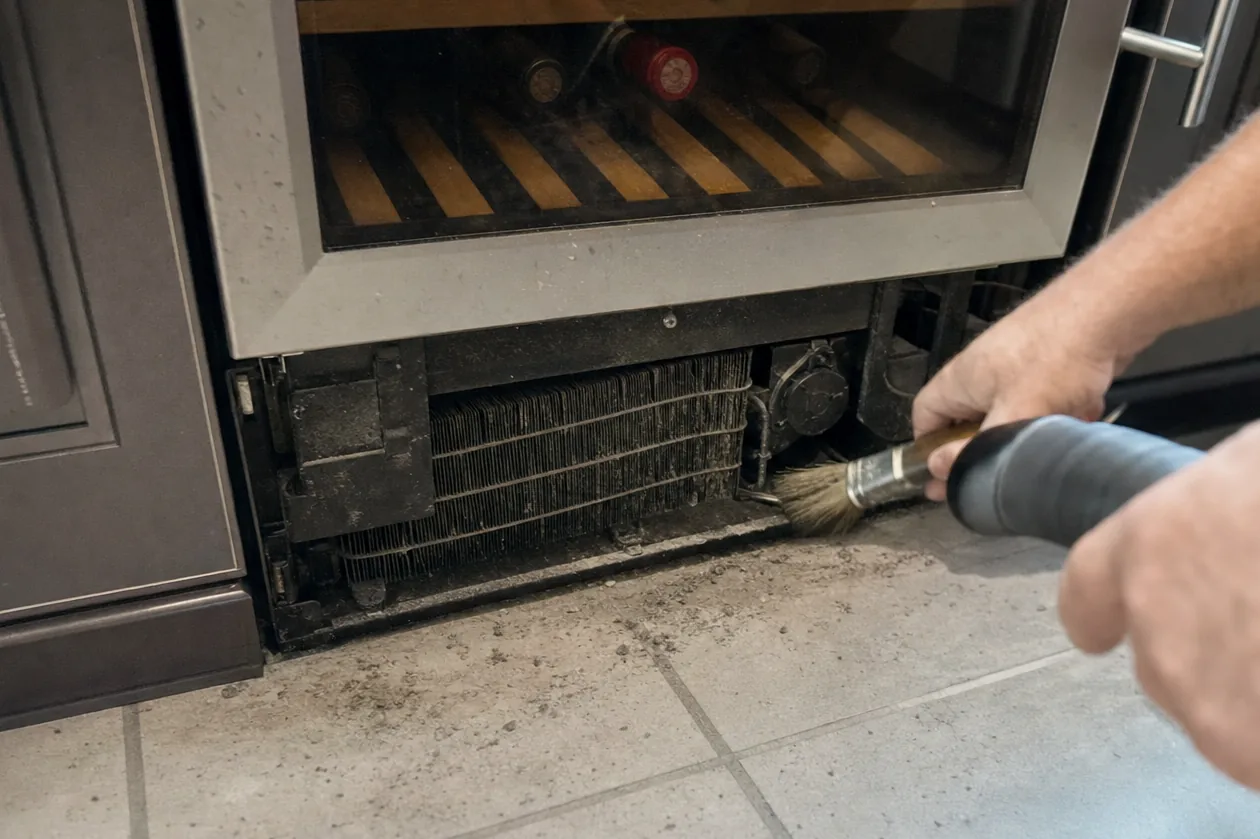
Most people have a mental picture of a refrigerator’s condenser as a black grid low down at the back, or a coil under the machine near the floor. On a built-in that picture is wrong, and being wrong about it is expensive.
The condenser on a Sub-Zero built-in sits at the top of the cabinet, behind the grille above the doors. It draws room air in through that slot, passes it across the fins to shed the heat the system has just removed from your food, and pushes it back out. It is at head height, in the middle of the kitchen, breathing whatever the room is breathing.
What that means in a neighbourhood like this one
Mandarin’s appeal is its tree cover. The subdivisions here were laid out through the 1970s, 1980s and 1990s with the live oaks largely left standing, and the older streets near the historic centre have a canopy that closes right over the road. It is a lovely place to live and it puts a heavy seasonal load into the indoor air: catkins and pollen in spring, fine litter through the year.
That load goes across the condenser fins. Add household dust, add a dog or a cat, and the gaps between the fins close up over a couple of seasons.
The appliance will not tell you
This is the part worth internalising. A fouled condenser does not produce a fault. The system compensates: it simply runs longer to reject the same amount of heat. Temperature stays where it should be, food stays good, nothing alarms.
What you notice, if you notice anything, is indirect:
- the kitchen feels warmer near the unit than it used to
- the appliance has become audible in a room where it used to disappear
- ice production falls off in August and recovers in October
- the electricity bill drifts up without an obvious cause
Then one hot afternoon, with the kitchen busy and the doors opening constantly, it finally cannot keep up, and that is the day the call comes.
Clearing it
Pull the grille — on most built-ins it comes away without tools or with a screw or two — and look at the fins. Clean fins look like a comb. Fouled fins look like felt.
A vacuum with a soft brush attachment, worked gently along the direction of the fins rather than across them, takes off most of it. Do not use anything that will bend the fins, and do not blast them with compressed air, which mostly pushes the debris deeper. If the mat is thick enough that vacuuming does not touch it, that is a job worth doing properly rather than aggressively.
Twice a year is right for a Mandarin house — once after the spring pollen finishes, once before summer. If you have an appliance on a covered porch or in an outdoor kitchen, that one needs looking at more often than the indoor cabinet, because it is drawing genuinely outdoor air.
Why we check it first
When someone calls to say a cabinet runs constantly, or that ice production has fallen away, or that the unit has become noisy, the condenser is the first thing we look at. It is free to rule out, it explains a large share of those complaints, and it has to be clear before any measurement of the sealed system means anything at all. A pressure reading taken across a blocked condenser tells you almost nothing.
It is also the reason we are comfortable charging one flat diagnostic fee rather than billing by the hour. Sometimes the honest answer to a service call is that the appliance is fine and the fins were packed, and that answer should not cost you more than the fee you agreed to.
What it costs
What does putting this right cost?
The bands that fit what this note is about. The diagnostic comes first and is credited toward the repair.
| What is being put right | Parts and labour |
|---|---|
| Diagnostic visit | $80 flat, credited toward the repair |
| Evaporator or condenser fan motor | $250–$550 parts and labour, after the diagnostic |
| Compressor or sealed-system repair | $940–$2,290 parts and labour, after the diagnostic |
Every line above is a range because the firm figure is written down after the diagnosis and not before it. The $80 covers coming out, testing the system and telling you what is wrong, and it comes off the repair the moment you say go ahead. The whole table, and what happens when a repair is not worth doing, is on the what it costs page.
If this is your fault
The repair page for it
- Sub-Zero built-in refrigerator running warm on one side A cabinet running warm on one side, frost creeping across the freezer wall, or a unit that runs and runs without ever settling down.
- Sub-Zero sealed system: running constantly, still drifting warm The refrigerant circuit itself — compressor, condenser, evaporator, drier and charge — and how to tell it apart from the cheaper faults that imitate it.
- Sub-Zero ice maker filling short: hollow cubes, no harvest Thin cubes, hollow cubes, a mould that fills but never harvests, and production that falls away through the summer.
Where this comes up
- Olde Mandarin and Lake Mandarin The wooded blocks around the historic village centre, where infill houses sit under heavy canopy and the spring pollen load is the enemy of a condenser.
- The Mandarin Road riverfront Deep lots under old live oaks along the St. Johns, where a single house often runs three or four separate refrigeration appliances.
All of the porch notes are listed on the reading page.
These notes are about cold: Sub-Zero refrigeration in Mandarin kitchens. Where one of them mentions a room being air conditioned, or a storm taking the power out, it is describing the conditions the cabinet works in. Loretto Cold Service does not service heating, air conditioning or ductwork and does not install them.
Questions we are asked
What readers ask after this one
- How often should the condenser be cleared in Mandarin?
- Once a year is a reasonable habit here, in spring after the live oak has finished shedding. Under heavy canopy, or in a house with pets, twice a year is not excessive. It is the one piece of maintenance that reliably extends the life of a compressor.
- Will the appliance warn me that the condenser is packed?
- No, and that is the point of the note. It holds its temperature, runs longer to shed the same heat and costs more to run, without any alarm or display change at all. The first sign is usually a hot afternoon when the cabinet finally cannot keep up.
Customer reviews
Owners who called about something like this
Three of the pool, chosen by this page and printed in full.
4.64.6 out of 5 across all 64 reviews published on this site
5 out of 5
Three cold appliances in this house and the one in the back hall was the culprit. He looked over all of them while he was here and charged only for the visit and the part that had to change.
Winifred O.August 2026
4 out of 5
The freezer side was fine, the fresh food side sat warm, and the air out of the vent was barely moving. He found the damper linkage snapped and replaced it, then explained why the fan was blameless.
Bridget M.May 2026
4 out of 5
Water was tracking down the inside of the cabinet and freezing at the base. He cleared the drain line, found the heater that keeps it open had failed, and fitted a new one so it would not simply return.
Perpetue G.January 2026
A wider selection, three-star entries first, is on the reviews page. All 64 are published across this site, beside the repair or the street each one came from.