Sub-Zero repair in Mandarin
Sub-Zero sealed system: running constantly, still drifting warm
The refrigerant circuit itself — compressor, condenser, evaporator, drier and charge — and how to tell it apart from the cheaper faults that imitate it.
The most expensive diagnosis, so it should be the last one
“Sealed system” means the closed refrigerant loop: compressor, condenser, metering device, evaporator, drier and the charge itself. It is sealed because nothing is supposed to enter or leave it for the life of the appliance. Opening it requires recovering the refrigerant into a proper recovery machine, which under federal law requires EPA Section 608 certification — a credential genuinely held here, and the only such credential this shop claims.
It is also the diagnosis most often reached too early. A cabinet running warm has a long list of cheaper explanations ahead of a refrigerant fault: a condenser packed with dust, an evaporator fan that has stopped, a defrost cycle that is no longer clearing the coil, a door seal letting in humid air, a sensor reading two degrees off, a control that has lost its mind after a power event. Every one of those is faster and cheaper to put right, and every one of them can present as “it isn’t getting cold.”
So we work down the list in order. If a shop reaches for the sealed system in the first ten minutes, ask what they ruled out to get there.
How a sealed-system fault actually reads
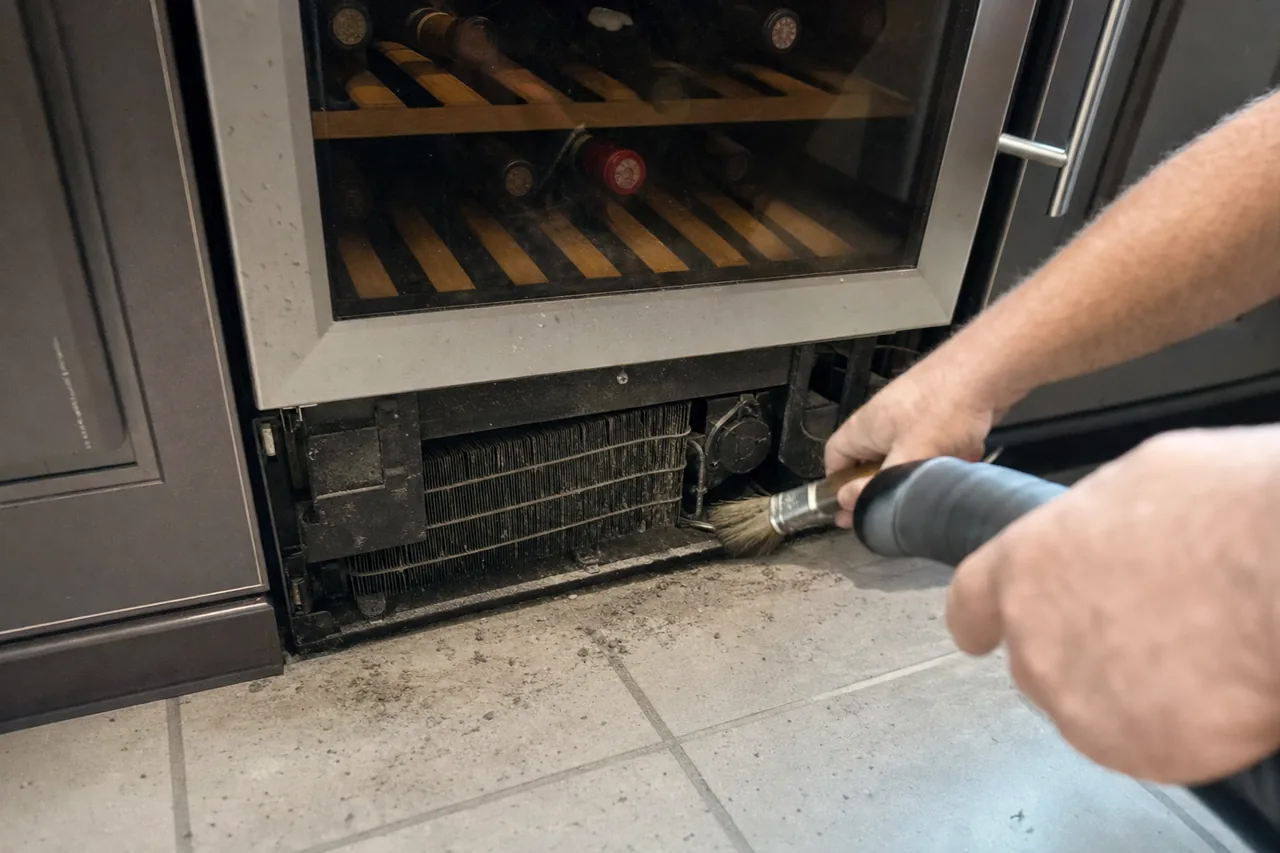
A few patterns are genuinely characteristic. A compressor that starts and stops again within seconds, repeatedly, is trying to start against a load it cannot overcome — that may be the compressor, its start components, or a restriction. Frost that forms on one part of the evaporator and stops abruptly partway along, while the rest of the coil stays bare, suggests the refrigerant is running out of the coil early, which is what a low charge or a partial restriction looks like. A unit that runs continuously and is unusually hot at the grille, with the condenser already clean, is another.
None of those are proof on their own. They are the readings that justify going further, and going further means pressures, temperatures and current draw measured on the appliance rather than guessed at from the symptom.
Two systems, two failures
Because a built-in carries a separate sealed system for each compartment, a sealed-system fault usually announces itself as an asymmetry: the freezer at zero and the refrigerator at fifty, or the reverse, with nothing else in the cabinet misbehaving. That asymmetry is genuinely useful. It rules out the shared causes — power, the main control, condenser airflow — in one observation, because those would have taken both compartments with them.
The honest conversation about cost
Sealed-system repair is real work. It involves recovery, replacing components, evacuating the system properly, and recharging by weight rather than by guess. On a unit that is otherwise sound — cabinet straight, doors true, controls healthy — it is usually worth doing, because the rest of the appliance is built to keep going and the cabinetry it sits in was cut to fit it.
On a unit that has already had several other failures, we will say so. You get a written estimate before any part is ordered and before any refrigerant is recovered, and the flat $80 diagnostic is credited toward the work if you go ahead. If the answer is that the repair does not make sense, you have still bought a clear answer rather than a series of guesses.
What a compressor replacement costs on a built-in
People search for the compressor by name because it is the part everyone has heard of, and it is a fair question to ask before the van arrives. The band for sealed-system work on this page’s table further down covers it, and it is the widest band we publish, for a reason worth stating: a compressor job is not one price because it is not one job. Recovering the existing charge, fitting the component, replacing the drier, pulling a deep vacuum and weighing a fresh charge back in are five separate pieces of work, and which of them a particular cabinet needs is established on site rather than assumed from the symptom.
Two things move the figure inside that band more than anything else. The first is whether the fault is the compressor itself or something upstream of it that was making the compressor look guilty — a start component, a restriction, a fan that stopped months ago. The second is access: a built-in fitted into a tight run of joinery takes longer to reach than an undercounter cabinet standing on its own.
Whether the repair is worth making at all is a separate question, and it has its own page: is it worth fixing sets the band against what the same cold storage costs new. On a full-height cabinet that sum is not close. On a wine or undercounter unit it can be, and there it is a judgement rather than an answer.
What we do not do
We do not top up a system and leave. Refrigerant does not get used up; if a charge is low, it left through a leak, and the leak is the repair. We do not work on any brand but Sub-Zero.
What it costs
What does Sub-Zero sealed system repair cost in Mandarin?
Narrowed to the bands that fit this fault rather than the whole book, because quoting you the sealed-system ceiling for an ice maker would be no use to anybody.
| What is being put right | Parts and labour |
|---|---|
| Diagnostic visit | $80 flat, credited toward the repair |
| Compressor or sealed-system repair | $940–$2,290 parts and labour, after the diagnostic |
| Evaporator or condenser fan motor | $250–$550 parts and labour, after the diagnostic |
Every line above is a range because the firm figure is written down after the diagnosis and not before it. The $80 covers coming out, testing the system and telling you what is wrong, and it comes off the repair the moment you say go ahead. The whole table, and what happens when a repair is not worth doing, is on the what it costs page.
Next
Related reading and other repairs
- The Condenser Is Above the Doors, Not Below The one piece of maintenance that reliably extends the life of a compressor, and the first thing we check on any cabinet that never stops running.
- Frost on the Back Wall of the Freezer Frost is not the freezer being too cold. It is humidity that entered the cabinet and then failed to be removed on the next defrost.
- Sub-Zero built-in refrigerator running warm on one side A cabinet running warm on one side, frost creeping across the freezer wall, or a unit that runs and runs without ever settling down.
- Sub-Zero integrated column: door out of true, drawers icing Panel-ready refrigerator and freezer columns that sit flush with the cabinetry until something moves, ices up or stops responding.
- Sub-Zero undercounter and drawers running warm in the afternoon The small units in islands, bars and outdoor kitchens, where heat, tight clearance and a long run from the main cabinet make life hard.
$80 flat diagnostic, credited toward the repair. You get a written estimate before any part is ordered or any labour begins.
A note on scope, because the words overlap: Sub-Zero sealed system repair is cooling work on a kitchen cabinet. Where this page talks about a room being air conditioned it is describing the weather the appliance works against, not a service offered. Loretto Cold Service does not service heating, furnaces, heat pumps, air handlers, thermostats or ductwork, and does not install them.
Questions we are asked
What owners ask about this repair
- How do I know it is really the sealed system and not something cheaper?
- You work the cheaper list first, and so do we: condenser airflow, the evaporator fan, the defrost cycle, the door seal, the sensors, the control. Every one of those can present as a cabinet that will not get cold, and every one is faster and cheaper to put right than opening the refrigerant circuit.
- Who is allowed to open the refrigerant circuit?
- Anyone recovering refrigerant has to hold EPA Section 608 certification. That is a federal requirement for the work, it is genuinely held here, and it is the only credential of its kind named anywhere on this site. It is not a manufacturer credential and nobody should read it as one.
- Is a sealed-system repair ever not worth doing?
- Sometimes it is not, and you will be told so in writing. A cabinet that has already had several failures, or one whose doors, controls and panels are all tired, may not earn the work. The pricing page sets the repair bands and the cost of replacing side by side, so the comparison is yours to make.
Customer reviews
Owners who called about this
Chosen for this page because they describe the same fault, and printed in full.
4.64.6 out of 5 across all 64 reviews published on this site
4 out of 5
The compressor was hot to the touch and the freezer was soft. He confirmed a restriction rather than a leak, and was candid that the work is long and the cabinet is old. We went ahead and it has run since.
Desmond A.March 2026
3 out of 5
Three weeks waiting on a part, and that was genuinely frustrating. He had warned me it would be ordered against the serial rather than carried on the van, so at least it was never a surprise.
Cormac N.February 2026
5 out of 5
He recovered the refrigerant into a proper machine rather than letting it go, and explained why federal law requires that. A small thing, but it told me what sort of shop I was dealing with.
Sybilla D.February 2026
A wider selection, three-star entries first, is on the reviews page. All 64 are published across this site, beside the repair or the street each one came from.