Sub-Zero repair in Mandarin
Sub-Zero wine storage: zones drifting apart, humidity falling
Dual-zone units where the two compartments have stopped agreeing, humidity has drifted, or the fan has become audible from across the room.
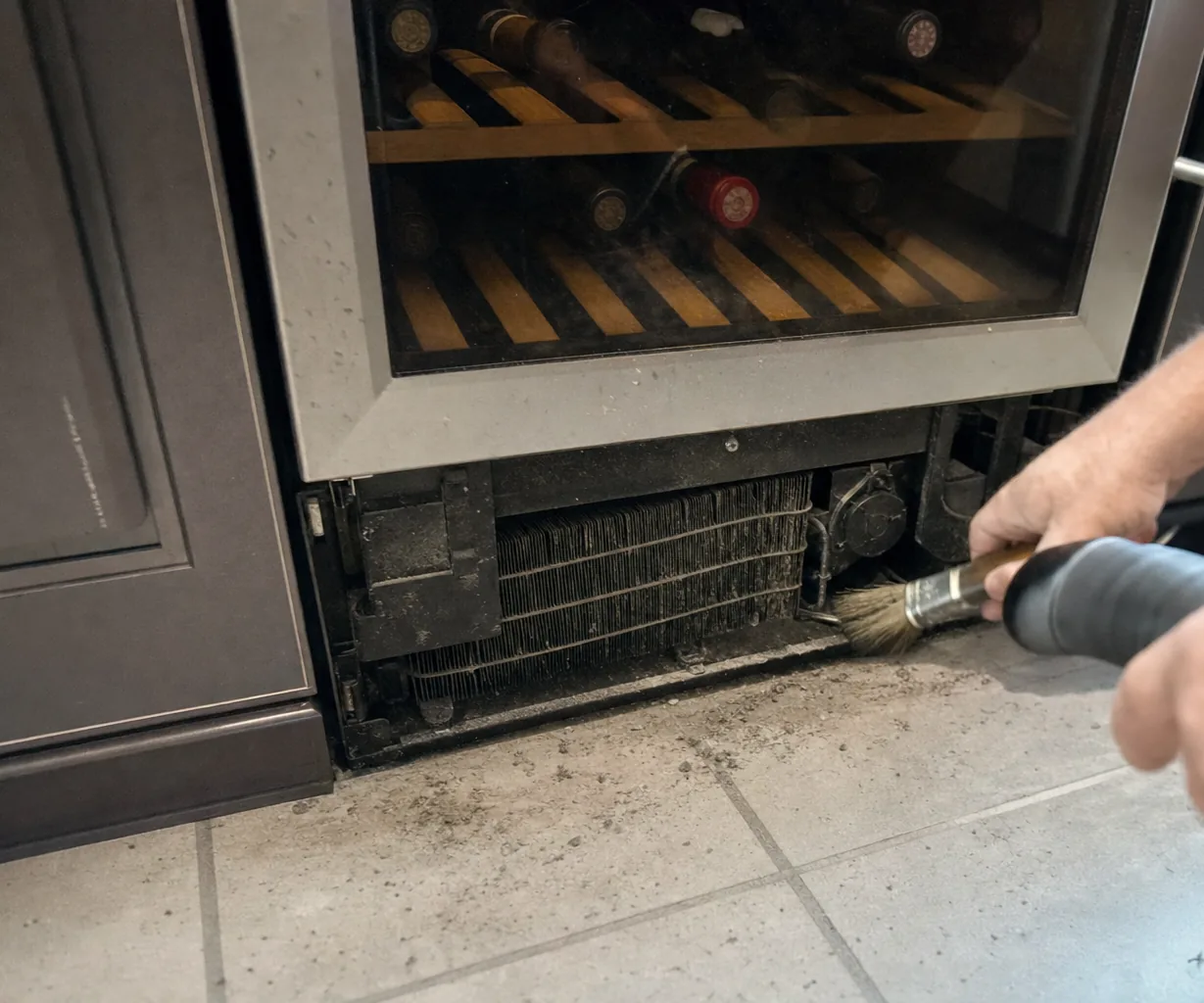
A wine unit is judged by a different standard
A refrigerator has one job: get cold and stay cold. A wine unit has a harder one. It has to hold a chosen temperature closely, hold it steadily, and hold humidity in a range that keeps a cork swollen — and in a dual-zone cabinet it has to do all of that twice, at two different set points, on either side of a single insulated box.
That is why wine storage generates a category of complaint that no other appliance does. Nobody calls about a refrigerator that is two degrees off. People call about a wine unit that is two degrees off, and they are right to, because two degrees sustained over a season is the difference between a bottle ageing and a bottle cooking.
Zones that have stopped agreeing
In a dual-zone cabinet the two compartments are separated by a divider and each is fed by its own damper or its own evaporator, depending on the unit. When the upper and lower readings converge — both settling at the same number regardless of what you set — the divider, the damper or the control has stopped keeping them apart. When one zone alone drifts up while the other holds, the fault sits in that zone’s air path.
Either way the first measurement we take is not the display. It is the actual temperature at bottle height, in more than one place in the cabinet, over enough time to see the cycle. A display reads a sensor; a sensor can be right about the air where it sits and wrong about the shelf two racks down.
Humidity, and why it drifts in this climate
Cork wants to stay slightly damp. Too dry and it shrinks, air gets past it, and the wine oxidises quietly over a year or two without ever showing a leak. Too wet and you get labels lifting and mould on the shelf ends.
Mandarin’s outdoor humidity is not the problem — it is the indoor swing. Houses here are air conditioned hard for eight months, which dries the room, and then opened up in the mild weeks, which soaks it. A wine cabinet in a butler’s pantry or a dining-room alcove sees both. When the door seal is even slightly imperfect, the cabinet follows the room instead of holding its own line, and the first symptom is dry corks rather than a temperature alarm.
Noise, in rooms where noise is noticed
Wine units are frequently installed in the quietest part of the house. A fan that has developed a whirr is measured against near silence, so complaints arrive early. Take them seriously: an audible change in a wine unit is often the condenser or evaporator fan bearing, and the same fan running rough is also moving less air, which is what put the zones out in the first place.
Vibration deserves the same attention. A unit that has begun to transmit through the cabinetry is not only annoying; sustained vibration is bad for sediment and bad for the bottle. Sometimes it is the levelling feet, sometimes a compressor mount, and once in a while it is a rack that has shifted.
Glass doors and condensation
A glass door is a thermal weak point by design. Some condensation on the outside of the glass in August, in a room that has just been opened up, is physics rather than fault. Condensation on the inside is different: it means warm humid air is entering and meeting the cold glass, which points back at the seal, the hinge or a door that no longer pulls itself fully shut.
What we do
Measure first, at bottle height, over a full cycle. Check the seal along its whole run rather than at one corner. Read the current the unit is drawing. Clear and inspect the condenser. Only then talk about parts.
The diagnostic is a flat $80, credited toward the repair, with a written estimate before anything is ordered. Genuine OEM parts, 365 days on parts, 90 days on labour. We work on Sub-Zero refrigeration only, and on no other brand.
What it costs
What does Sub-Zero wine storage repair cost in Mandarin?
Narrowed to the bands that fit this fault rather than the whole book, because quoting you the sealed-system ceiling for an ice maker would be no use to anybody.
| What is being put right | Parts and labour |
|---|---|
| Diagnostic visit | $80 flat, credited toward the repair |
| Defrost heater, thermostat or sensor | $250–$640 parts and labour, after the diagnostic |
| Evaporator or condenser fan motor | $250–$550 parts and labour, after the diagnostic |
| Door gasket or seal replacement | $240–$620 parts and labour, after the diagnostic |
Every line above is a range because the firm figure is written down after the diagnosis and not before it. The $80 covers coming out, testing the system and telling you what is wrong, and it comes off the repair the moment you say go ahead. The whole table, and what happens when a repair is not worth doing, is on the what it costs page.
Next
Related reading and other repairs
- Condensation Along the Door Line A seal fails slowly and invisibly. Long before it lets go, it is letting in humid air, and the cabinet is paying for it in compressor hours.
- After the Power Blinks, and What to Check A dark panel does not always mean a dead board. The useful first question is whether the compartment is still holding temperature.
- Sub-Zero built-in refrigerator running warm on one side A cabinet running warm on one side, frost creeping across the freezer wall, or a unit that runs and runs without ever settling down.
- Sub-Zero integrated column: door out of true, drawers icing Panel-ready refrigerator and freezer columns that sit flush with the cabinetry until something moves, ices up or stops responding.
- Sub-Zero undercounter and drawers running warm in the afternoon The small units in islands, bars and outdoor kitchens, where heat, tight clearance and a long run from the main cabinet make life hard.
$80 flat diagnostic, credited toward the repair. You get a written estimate before any part is ordered or any labour begins.
A note on scope, because the words overlap: Sub-Zero wine storage repair is cooling work on a kitchen cabinet. Where this page talks about a room being air conditioned it is describing the weather the appliance works against, not a service offered. Loretto Cold Service does not service heating, furnaces, heat pumps, air handlers, thermostats or ductwork, and does not install them.
Questions we are asked
What owners ask about this repair
- My two wine zones now read the same. What does that mean?
- It means whatever keeps them apart has stopped: the divider, the damper feeding one side, or the sensor reading it. A dual-zone cabinet holds two set points on either side of one insulated box, so when the two readings converge the fault lives in the separation rather than in the cooling.
- Why do corks dry out here when the outdoor air is so humid?
- Because the cabinet follows the room, and the room is dried hard by its air conditioning for much of the year. Outdoor humidity never reaches the bottles. When a door seal is even slightly imperfect the cabinet takes on that dried indoor air, and dry corks appear long before any temperature alarm does.
- The unit has become audible from the next room. Is that serious?
- It is worth looking at. Noise from a wine cabinet is usually a fan bearing, a blade catching on something, or a unit working harder than it should because its airflow has been restricted. None of that is urgent on the day, but what sits underneath it is cheaper to catch early than late.
Customer reviews
Owners who called about this
Chosen for this page because they describe the same fault, and printed in full.
4.64.6 out of 5 across all 64 reviews published on this site
5 out of 5
Corks were drying out and I could not understand it in a climate like this one. He explained that the cabinet was following the dried indoor air through an imperfect seal. A new gasket settled it.
Ambrose L.December 2025
5 out of 5
We keep a lot of bottles and I wanted somebody who understood why two degrees matter. He did. He took the humidity as seriously as the temperature and never treated it as just a refrigerator.
Percival M.November 2025
4 out of 5
Condensation on the inside of the glass door every morning. He watched how the door landed before assuming anything, and the answer was alignment rather than a part I had to pay for.
Rosamund B.November 2025
A wider selection, three-star entries first, is on the reviews page. All 64 are published across this site, beside the repair or the street each one came from.